Why Is Dubai Called the City of Gold? History, Trade and What It Means for Buyers
Dubai is called the City of Gold because, for the better part of a century, gold has been one of the main things the city buys, sells, refines and re-exports. The nickname began with the creek-side traders of Deira in the 1940s, grew with the duty-free policy that still applies today, and became official branding when the Dubai Shopping Festival started giving away kilos of it in raffles. This page explains how that happened and, more usefully, what the title actually means for a resident or visitor who wants to buy gold in Dubai today.
Where the City of Gold name comes from: Deira in the 1940s–60s
Long before the skyscrapers, Dubai was a small port on a tidal creek with a reputation for light regulation and low taxes. From the 1940s onward merchants on the Deira bank of the creek, many of them from Iran and the Indian subcontinent, built a trade in gold that was bought in Europe and the Gulf and shipped onward to India and Iran, where demand was enormous and import rules were tight. Dhows left the creek with small bars packed for buyers across the Arabian Sea, and the money came back to fund the souk's first proper shops.
Through the 1950s and 60s this re-export business was, by most accounts, the single largest source of trading income in the emirate, and it explains why the Dubai gold trade and the Gold Souk sit in Deira rather than in the newer parts of town. Sheikh Rashid bin Saeed Al Maktoum's decision to dredge the creek in the late 1950s meant larger vessels could dock, and the gold merchants were among the first to benefit. When oil revenue arrived in the late 1960s, gold was already a settled industry with its own bankers, assayers and courier networks.
Today's visitors who walk the lane of the Deira Gold Souk are standing on the same ground where that trade began; several family businesses in the souk trace their start to that period.
From re-export hub to global marketplace: DMCC and the exchange era
The modern phase of the Dubai gold city story started in 2002 with the creation of the Dubai Multi Commodities Centre (DMCC), a free zone in Jumeirah Lakes Towers designed to give the gold, diamond and commodities trades a formal home. DMCC introduced the Dubai Good Delivery standard for refined bars, attracted refineries and bullion dealers to set up locally, and launched the Dubai Gold & Commodities Exchange (DGCX) in 2005 so that gold futures could be traded in the Gulf time zone rather than only in London or New York.
The result is that Dubai is now routinely counted among the world's largest physical gold trading hubs. Hundreds of tonnes a year pass through the emirate in one form or another: refined bars arriving from mines and recyclers, jewellery leaving for the subcontinent and Africa, and bullion traded between banks and dealers in the free zone. Dubai Airport's cargo terminals and the city's position between African, European and Asian markets make it a natural transit point.
For an ordinary buyer, this scale matters in one practical way: supply is deep and competition is intense, which keeps retail margins thin. The gram rate itself is set by the international spot price and converted into dirhams at the fixed peg; our page on how the Dubai gold rate is set explains the mechanics.
Zero duty: the policy that keeps Dubai gold competitive
The UAE charges no import duty on gold. That single line of policy is the biggest reason the City of Gold label has survived the arrival of online bullion dealers and competing hubs. In India, Pakistan, Nepal, Egypt and many other countries where Dubai's customers live, gold attracts customs duty and sales tax that together can add a noticeable percentage to the price of the metal; in Dubai the only tax is the 5% VAT introduced in 2018, which tourists can reclaim at departure and which does not apply at all to investment-grade bars and coins.
Because the metal price is global, the saving a buyer makes in Dubai comes entirely from what is not added on top: no duty, low VAT, and labour charges held down by hundreds of shops competing for the same customer. Our guide to VAT on gold in the UAE explains which purchases are zero-rated and how the Planet refund works, and the page on making charges in Dubai shows how to compare the labour component between shops.
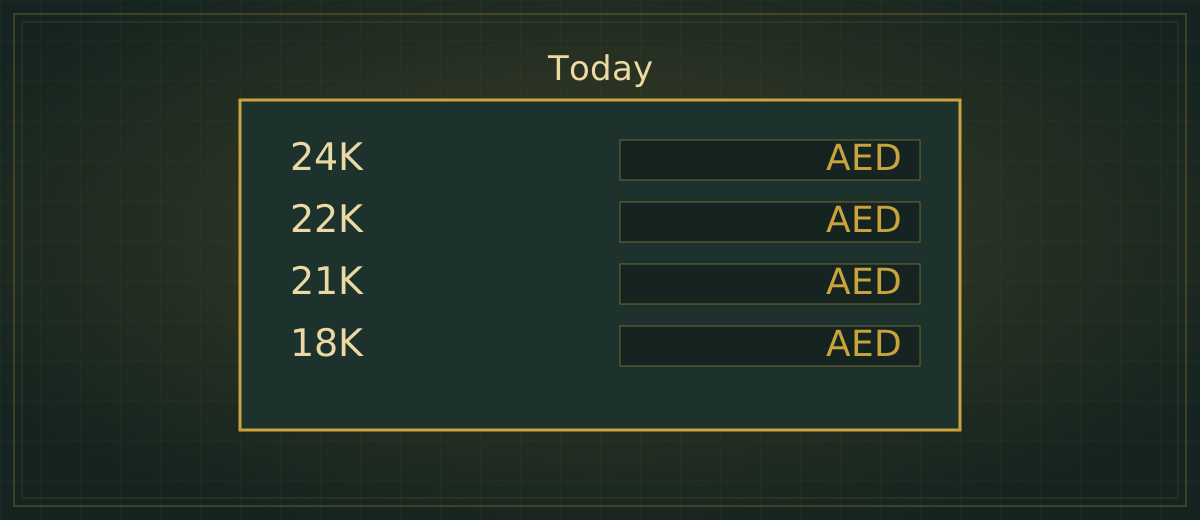
The live strip below shows what the metal itself costs per gram at each karat right now. Everything a shop adds beyond that number is negotiable; the number itself is not.
…
The Gold Souk: the City of Gold's shop window
Ask any taxi driver for the City of Gold and he will take you to the Deira Gold Souk, a covered pedestrian lane in Al Ras with a few hundred small jewellers packed side by side. Windows hang with 22K bridal sets, 21K Arabic bangles, chains sold by the metre and, in a couple of famous displays, enormous rings and necklaces made for the cameras. The rate board at each door shows the same Dubai Gold & Jewellery Group figure, so what you negotiate is the making charge and the final rounding, not the metal.
Around the main lane sit the wholesale buildings, the Gold Souk Extension with its air-conditioned shops, and the trading floors where dealers from East Africa and South Asia buy in kilos. The Gold Souq metro and bus station on the Green Line put the whole area within a short walk of public transport, and an abra ride across the creek from Bur Dubai for a dirham or two remains the most atmospheric way to arrive.
Buyers who prefer parking and air conditioning are not short of alternatives. The Gold & Diamond Park on Sheikh Zayed Road groups manufacturers and showrooms in one building, and the large chains listed in our guide to the best gold jewellers in the UAE have branches in Meena Bazaar, Karama and every big mall.
Dubai Shopping Festival and the City of Gold campaigns
The nickname was turned into a marketing slogan in the mid-1990s. The first Dubai Shopping Festival in 1996 included gold raffles and a jewellery promotion coordinated by the city's gold retailers, and the format has been repeated every winter since: buy above a certain amount at a participating shop, receive a coupon, and enter a draw for kilos of gold or a cash equivalent. Around the same time the Dubai Gold & Jewellery Group adopted "Dubai City of Gold" as the banner for its joint promotions, and the phrase has stayed on posters, festival stages and airport advertising ever since.
Seasonal campaigns still shape when locals buy. During the Shopping Festival and the summer promotions, shops compete on reduced or waived making charges and free add-ons such as small coins; in the weeks before Diwali, Eid and the winter wedding season demand rises and discounts are thinner. If you are flexible about timing, the festival weeks are usually the best moment to buy plain gold, while the quiet months between seasons are when a shop is most willing to negotiate on a large bridal set.
None of this changes the gram rate, which moves with the international market. For the pattern over recent months see the gold price history page.
What the City of Gold title means for buyers today
Strip away the slogans and the City of Gold offers four concrete advantages. First, price: no duty and a competitive retail market mean the total cost of a plain 22K or 21K piece is usually lower than in the buyer's home country, even after VAT. Second, choice: the souk, the malls and the wholesale buildings stock Indian, Arabic, Turkish, Italian and Singaporean designs under one roof. Third, trust: shops are licensed by Dubai Economy, gold is hallmarked, and every receipt shows weight, karat and the rate used. Fourth, convenience: you can buy on a Sunday evening, pay by card and claim a VAT refund at the airport the next morning.
There are also things the title does not mean. It does not mean gold is cheaper per gram than anywhere else; the metal costs the same everywhere. It does not mean every shop is equal; making charges vary widely and a few tourist-facing counters will quote high to visitors who have not checked the board. And it does not mean buying is a guaranteed investment; gold can fall as well as rise, and jewellery carries a labour cost you will not recover on resale.
Our step-by-step guide to buying gold in Dubai covers hallmarks, receipts and how to check the rate before you negotiate.
A short checklist for first-time buyers in the City of Gold
- Know the rate before you go. Check the live gram price for your karat on this site, then confirm it against the board inside the shop. The two should match to within a dirham or so.
- Ask for the making charge separately. A good jeweller will quote the metal value, the labour and the VAT as three lines. If the shop only quotes a total, ask it to break it down.
- Compare at least three shops. The metal is identical; the labour and willingness to negotiate are not. In the souk, walking out politely often brings the price down.
- Check the hallmark and the receipt. Look for the purity stamp (916 for 22K, 875 for 21K, 750 for 18K) and make sure the invoice shows weight, karat, rate and the shop's licence details. You will need it for a VAT refund and for any future resale.
- Tourists: keep the tax-free tag. Purchases above AED 250 at registered shops are eligible for a VAT refund via the Planet counters at departure, provided the goods leave the country within 90 days.
- Indian residents: mind the customs limit. The duty-free allowance for jewellery is modest; the rules are summarised on our page about carrying gold from Dubai to India.
Prices on this site are indicative and update automatically from the international market; your receipt will show the exact rate applied at the time of purchase.
Frequently asked questions
Why is Dubai called the City of Gold?
Because gold has been central to Dubai's economy since the 1940s, when Deira merchants built a re-export trade to India and Iran. The emirate kept gold duty-free, developed the Gold Souk into a landmark, created DMCC and the DGCX exchange, and promoted the name through the Dubai Shopping Festival's gold raffles. Today it is one of the world's largest physical gold trading hubs.
Is gold really cheaper in Dubai than in India or elsewhere?
The metal costs the same per gram worldwide, so the saving is in what is added on top. Dubai has no import duty, only 5% VAT (refundable for tourists), and intense competition that keeps making charges low. In India and many other countries customs duty and sales tax add a noticeable percentage, which is why a Dubai purchase usually works out cheaper in total.
What is the Dubai City of Gold rate?
People searching for a "City of Gold rate" usually mean the daily Dubai retail rate published by the Dubai Gold & Jewellery Group and displayed in every shop. It follows the international spot price converted into dirhams at the fixed peg of 3.6725 per dollar. The live strip on this page shows that rate per gram for 24K, 22K, 21K and 18K.
When did the Dubai Shopping Festival start giving away gold?
From its first edition in 1996 the Dubai Shopping Festival has included gold promotions and raffles organised with the city's jewellers. The format of spending a minimum amount at a participating shop to enter a draw for kilos of gold has continued every winter, and similar raffles now run during the summer promotions as well.
Where should a first-time visitor buy gold in Dubai?
The Deira Gold Souk is the classic choice for variety and negotiation, reachable by the Green Line metro. For air conditioning, parking and fixed prices, the Gold & Diamond Park on Sheikh Zayed Road and the big-brand showrooms in malls, Meena Bazaar and Karama are easier. Whichever you choose, check the day's rate first and ask for the making charge separately.
Does the City of Gold name apply to the other emirates too?
The nickname belongs to Dubai, but the same daily rate and the same duty-free policy apply across the UAE. Sharjah's Central Souk and Rolla area, Ajman's gold souk and Abu Dhabi's Madinat Zayed Gold Centre all trade at the national rate; what differs is the design mix and the making charges, which are often lower in the northern emirates.
Keep reading
-
 Dubai Gold Souk in Deira: Guide to Shops, Opening Hours, Haggling and the Extension
Guide to the Deira Gold Souk in Dubai: layout in Al Ras, the Gold Souk Extension, opening hours, haggling, scams to avoid, bridal shopping and transport.
-
 How to Reach Dubai Gold Souk: Gold Souq Metro Station, Bus Station, Parking, Abra and Taxi
How to reach Dubai Gold Souk: Gold Souq and Al Ras metro (Green Line), Gold Souq Bus Station, parking, abra from Bur Dubai and taxi drop-off, all compared.
-
 Is Gold Cheaper in Dubai? Price Comparison vs India, UK, Pakistan and Saudi
Is gold cheaper in Dubai? Why the bill is lower (no import duty, 5% refundable VAT, low making charges), a worked comparison vs India, UK and Saudi.
-
 How to Buy Gold in Dubai – The Complete Buying Guide for Residents and Tourists
How to buy gold in Dubai step by step: choosing a karat, reading the rate board, the invoice, hallmarks, bargaining on making charges and VAT refund.
-
 Who Sets the Gold Rate in Dubai? The DGJG Rate, Khaleej Times, Gulf News and the Spot Price Explained
Who sets the gold rate in Dubai: the Dubai Gold & Jewellery Group rate, its link to London and COMEX spot, why Khaleej Times and Gulf News print one price.
-
 Best Gold Jewellers in the UAE – Malabar, Joyalukkas, Damas and the Big Chains Compared
Best gold shops in Dubai and the UAE: Malabar Gold, Joyalukkas, Damas, Pure Gold, Al Romaizan and Kalyan compared. Why the rate is the same, what differs.
-
 Gold Centre Building and Gold Land Building in Deira: Dubai's Wholesale Gold Buildings Explained
What the Gold Centre and Gold Land buildings in Deira are, who shops there, how they differ from the Gold Souk, plus Karama's gold buildings and Sharjah's.
-
 Sharjah Gold Souk Guide: Central (Blue) Souk Gold Wing, Rolla Gold Row and the Sharjah Gold Centre
Where to buy gold in Sharjah: the Central (Blue) Souk gold wing, the Rolla gold row, the Gold Centre and Al Arsa Souk, with hours, parking and prices.