Gold Karats Explained: 24K vs 22K vs 21K vs 18K (999, 916, 875, 750) in the UAE
Karat is the measure of how much pure gold a piece contains, on a scale where 24 karat is pure. In the UAE you will meet four karats constantly: 24K for bars and coins, 22K in Indian-style jewellery, 21K in Arab and Gulf designs, and 18K in diamond-set and branded pieces, with 14K appearing in some imported fashion jewellery. This guide explains what each karat is, what the 999, 916, 875, 750 and 585 stamps mean, how colour, durability, price and resale differ, and which one makes sense for the piece you are about to buy.
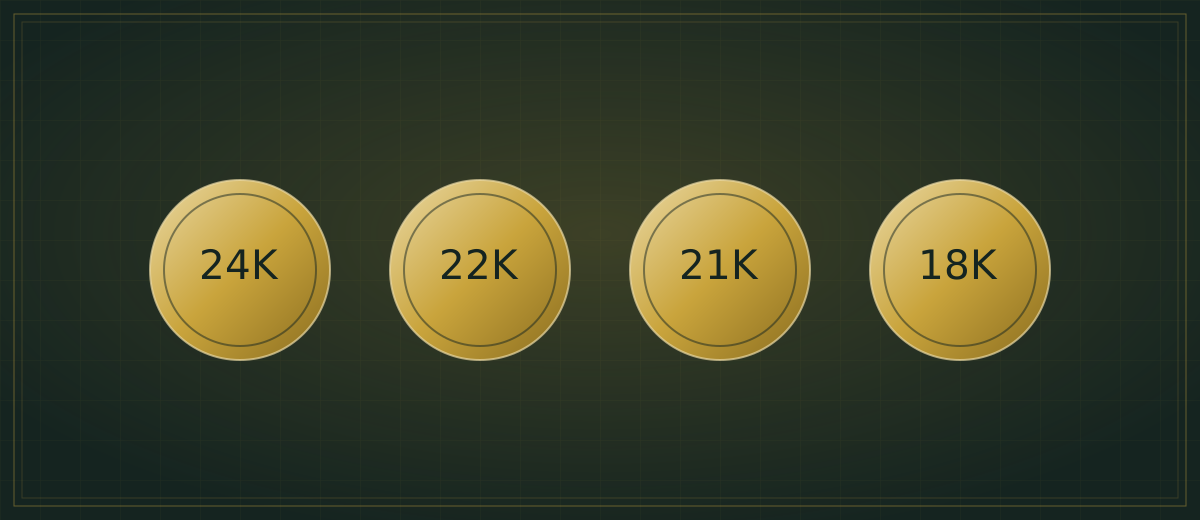
What karat means and how the 999, 916, 875 and 750 stamps work
The karat system divides gold into 24 parts. A 24 karat piece is 24 parts gold out of 24, so it is pure; 22 karat is 22 parts gold and 2 parts other metal; 18 karat is 18 parts gold and 6 parts alloy. The alloy is usually copper, silver, zinc or palladium, chosen to make the gold harder and sometimes to change its colour.
The three-digit stamp you find inside a ring, on the clasp of a chain or on the back of an earring says the same thing in parts per thousand, which is how refiners and hallmarking offices express purity:
- 999 = 99.9% gold = 24K
- 916 = 91.6% gold = 22K
- 875 = 87.5% gold = 21K
- 750 = 75.0% gold = 18K
- 585 = 58.5% gold = 14K
These numbers matter because the price of any piece starts from them. The daily gold rate is published for 24K and each lower karat is that rate multiplied by its purity: 22K is 91.6% of the 24K price, 21K is 87.5%, 18K is 75%. A shop cannot charge a 22K metal price for a piece stamped 875, and a buyer paying for scrap will go by the stamp and a test, not by what the seller says. The hallmark and purity guide explains how to confirm the stamp is genuine.
24 carat gold (999): bars, coins and the purest option
24 carat gold is as pure as commercial gold gets, usually 99.9% and sometimes 99.99% for refinery bars. Its colour is a deep, slightly orange yellow, and it is soft enough to mark with a fingernail. That softness is why it is rarely used for jewellery that is worn daily: a 24K ring would bend, scratch and lose shape within months.
In the UAE, 24K is the karat of gold bars and bullion coins. Because it is investment-grade, it is zero-rated for VAT, and it is bought and sold with the smallest spread of any gold product. Some Chinese and East Asian jewellery is made in 24K or 999 for cultural reasons, and you will find it in a few Deira shops, but it is sold as a store of value more than as wearable jewellery. The 24K gold rate page shows the live price in AED per gram, tola and ounce.
If your goal is to hold gold for savings rather than to wear it, 24K is the karat most residents choose, because every dirham goes into metal rather than labour or alloy.
22K gold (916): the standard for Indian and South Asian jewellery
22K gold, stamped 916, is 91.6% gold with roughly 8% copper and silver. It keeps a rich yellow colour very close to pure gold while being hard enough for bangles, chains, bridal necklaces and temple jewellery. It is the default karat in India, Pakistan, Bangladesh and Sri Lanka, which is why the Indian-owned shops of Meena Bazaar, Karama and most of the Deira Gold Souk are stocked with 916 gold.
Advantages: high metal content, so the resale value stays close to the gram rate; traditional designs are made for it; it is easy to sell back anywhere in the Gulf or South Asia. Disadvantages: it is still relatively soft, so fine filigree wears over time, prongs cannot hold diamonds securely, and thin pieces dent. Pure 22K is also unsuitable for white or rose colours, because there is too little alloy to shift the hue.
The difference between 22K and 24K is therefore a difference of purpose. 24K is money in metal form; 22K is money you can wear. The 22K gold rate page carries the live price, and the bangles guide shows what typical 22K pieces weigh.
What is 21K gold (875)? The Gulf and Arab favourite
21K gold, stamped 875, is 87.5% gold with 12.5% alloy. It sits between 22K and 18K and is the most common jewellery karat for Emirati, Saudi, Egyptian, Jordanian, Lebanese and North African buyers. Walk into an Arab-owned shop in the Gold Souk, Sharjah's Central Souk or Abu Dhabi's Madinat Zayed and most of the display will be 21K.
Why 21K? The extra alloy makes it noticeably harder than 22K, so it suits the chunky bangles, wide necklaces and heavy sets of Gulf and Levantine tradition, as well as the bolder modern Italian-style designs sold in the same shops. The colour is a warm yellow, a shade deeper than 18K and a shade lighter than 22K. Price-wise, it is 87.5% of the 24K rate, so a 21K piece of the same weight costs about 4.5% less in metal than its 22K equivalent.
Resale is straightforward across the Gulf and the Arab world, where 875 is recognised instantly; in India it is less familiar and buyers there may test and discount it. Check the 21K gold rate today before shopping for a set.
18K gold (750) and 14K (585): diamonds, designer pieces and daily wear
18 karat gold is 75% gold and 25% alloy, stamped 750. The high alloy content makes it hard, scratch-resistant and able to hold stones securely, which is why practically every diamond ring, tennis bracelet and branded design in the UAE's malls is 18K. It is also the karat used for white gold and rose gold, because 25% alloy is enough to change the colour; our page on white, rose and black gold goes into the alloys.
The 18 carat gold price is 75% of the 24K rate per gram, but 18K jewellery rarely feels cheap because the labour, design and stones dominate the bill. When you sell an 18K piece, the buyer pays for the 75% gold content only; the stones are valued separately or not at all, and the brand premium disappears. That is the trade-off: better durability and design, weaker resale as a proportion of what you paid.
14K gold, stamped 585, is 58.5% gold and is common in American and some European fashion jewellery. It is tougher and cheaper than 18K and appears in the UAE mainly in imported brands and in some men's rings and watches. Below 14K, pieces such as 9K are rare here, and many UAE buyers will not accept them for resale at all.
24K vs 22K vs 21K vs 18K: comparison table
The table pulls together the practical differences. The price column is relative to the 24K gram rate; use the live gold calculator for the dirham figure.
| Karat | Stamp | Gold content | Metal price vs 24K | Colour | Hardness | Typical use in the UAE | Who buys it |
|---|---|---|---|---|---|---|---|
| 24K | 999 | 99.9% | 100% | Deep orange-yellow | Very soft | Bars, coins, some East Asian jewellery | Savers, investors |
| 22K | 916 | 91.6% | 91.6% | Rich yellow | Soft | Bangles, chains, bridal sets | Indian, Pakistani, Bangladeshi, Sri Lankan families |
| 21K | 875 | 87.5% | 87.5% | Warm yellow | Medium | Gulf and Arab sets, heavy bangles, Italian designs | Emirati, Gulf, Egyptian, Levantine, North African buyers |
| 18K | 750 | 75% | 75% | Lighter yellow; also white and rose | Hard | Diamond jewellery, designer and branded pieces | Everyone buying stones or brands; Western buyers |
| 14K | 585 | 58.5% | 58.5% | Pale yellow; white and rose | Very hard | Imported fashion jewellery, men's rings | Western and some Filipino buyers |
One more row worth remembering: making charges usually rise as karat falls, because harder alloys take more work to shape and because 18K and 14K pieces tend to be more intricate. A 10 g 22K bangle and a 10 g 18K bracelet can end up at similar invoice totals even though the metal values are far apart.
Which karat should you buy in the UAE? A practical guide
Match the karat to the job the piece has to do, not to a number that sounds better.
- Saving or investing: 24K bars or coins. No making charges, no VAT, easiest resale.
- Bridal sets and gifts for Indian or South Asian family: 22K. It is what relatives expect, what the home market accepts and what holds value best among wearable karats.
- Gulf-style sets, heavy bangles, Arab wedding gold (shabka): 21K. Harder than 22K, universally resold across the Arab world.
- Diamond rings, everyday rings worn with keys and gym bags, white or rose gold: 18K. Buy it for design and durability, not as a store of value.
- Children's jewellery or pieces that take knocks: 18K or 21K, because 22K bends.
Whatever you choose, remember three things. First, the gram rate for every karat is public, so compare quotes on labour, not on metal. Second, VAT at 5% applies to all jewellery regardless of karat; only 99%-plus investment gold is zero-rated, as the VAT guide explains. Third, when you later sell gold in Dubai, the buyer values the stamped karat at that day's rate minus a margin, and recovers none of the making charges, so the higher the karat and the plainer the piece, the smaller your loss.
Always ask for the karat to be written on the invoice in both karat and fineness (for example "21K / 875"). It protects you at resale and when a tourist VAT refund or a customs officer asks what the piece is.
Frequently asked questions
What is the difference between 22K and 24K gold?
24K is 99.9% pure and too soft for daily wear, so it is used for bars and coins. 22K is 91.6% gold with 8.4% alloy, which makes it hard enough for bangles and chains while keeping a rich yellow colour. 22K costs 91.6% of the 24K rate per gram, and both are easy to resell in the UAE.
What does 916 gold mean?
916 is the fineness stamp for 22 karat gold: 916 parts per thousand, or 91.6%, is pure gold. It is the standard purity for Indian-style jewellery sold in Dubai, Sharjah and Abu Dhabi. A piece stamped 916 should be priced at 91.6% of the 24K gram rate plus making charges and VAT.
What is 21K gold and who buys it?
21K gold is 87.5% pure and stamped 875. It is the most common jewellery karat for Emirati, Gulf, Egyptian and Levantine buyers because it is harder than 22K and suits heavy traditional sets. It is priced at 87.5% of the 24K rate and resells easily across the Arab world.
Is 18K gold a good investment?
18K is a good choice for jewellery that must last, especially diamond-set and designer pieces, but it is a weak investment. Only 75% of its weight is gold, making charges and stones form much of the price, and at resale you receive only the metal value. For savings, most UAE residents choose 24K bars or 22K plain pieces.
What is 750 gold and what is 999 gold?
750 is the stamp for 18 karat gold, meaning 75% gold and 25% alloy; it is used for diamond jewellery, white gold and rose gold. 999 is the stamp for 24 karat gold, 99.9% pure, used for bars, coins and some East Asian jewellery. Both stamps are recognised by every jeweller and gold buyer in the UAE.
Can I tell the karat by colour alone?
Only roughly. 24K is a deep orange-yellow, 22K a rich yellow, 21K slightly lighter and 18K lighter still, but polishing, plating and alloy choices blur the differences. Rely on the stamp and, for anything valuable, on an electronic or acid test at a jeweller rather than on colour.
Keep reading
-
 22K Gold Rate Today in UAE – 22 Carat Gold Price in Dubai per Gram, 10 g and Tola
Live 22K gold rate today in UAE and Dubai per gram, 10 g and tola in AED and USD: what 916 means, making charges, buying vs selling rate, hallmark checks.
-
 21K Gold Rate Today in UAE – 21 Carat Gold Price per Gram in Dubai (875 Gold)
Live 21K gold rate today in UAE and Dubai per gram and 10 g: what 875 gold is, 21K vs 22K, bridal shabka budgeting, buying tips for Sharjah and Ajman.
-
 18K Gold Rate Today in UAE – 18 Carat Gold Price per Gram in Dubai (750 Gold)
Live 18K gold rate today in Dubai and the UAE per gram: what 750 gold is, white, rose and yellow 18K, Italian chains, diamond and designer pieces, resale.
-
 24K Gold Rate Today in Dubai & UAE – 24 Carat Gold Price per Gram, Bars and Coins
Live 24K gold rate today in Dubai and the UAE per gram, 10 g, tola and ounce: 999 purity, bar and coin premiums, VAT zero-rating, 999 bangles and storage.
-
 Gold Hallmarks and Purity Checks in the UAE – 916, 875, 750 Stamps and How to Test Gold
Gold hallmarks in the UAE explained: what 999, 916, 875 and 750 mean, Dubai conformity marks, the Indian BIS stamp, XRF testing and home purity tests.
-
 White Gold, Rose Gold, Black Gold and Champagne Gold: What They Are and What They Cost in Dubai
White gold, rose gold, black gold and champagne gold explained: alloys, rhodium plating, allergies, care, what to check on the stamp and prices in Dubai.
-
 Gold Ring Price in Dubai – What a 22K, 21K or 18K Ring Really Costs
Gold ring price in Dubai and the UAE: typical weights for ladies' and men's rings, the weight × rate + making charge formula, 22K vs 21K vs 18K rings.
-
 Gold Chain Price in Dubai – 22K Chains for Men and Women by Weight
Gold chain price in Dubai: what 10 g, 20 g and 50 g chains cost by karat, rope, Figaro, box and Cuban designs, hollow vs solid gold, and making charges.