Who Sets the Gold Rate in Dubai? The DGJG Rate, Khaleej Times, Gulf News and the Spot Price Explained
The gold rate you see in Khaleej Times, Gulf News, Al Khaleej and on every shop wall in the UAE comes from one source: the Dubai Gold & Jewellery Group, the trade body of the emirate's jewellers, which publishes a retail rate per gram for each karat and refreshes it during the day. That rate is not a local invention. It is the international spot price of gold in US dollars, converted into dirhams at the fixed peg and adjusted slightly for the local trade. This page explains who sets it, how it is derived, when it changes, why the newspapers all print the same figure, and how the live board below relates to the number in the shop.
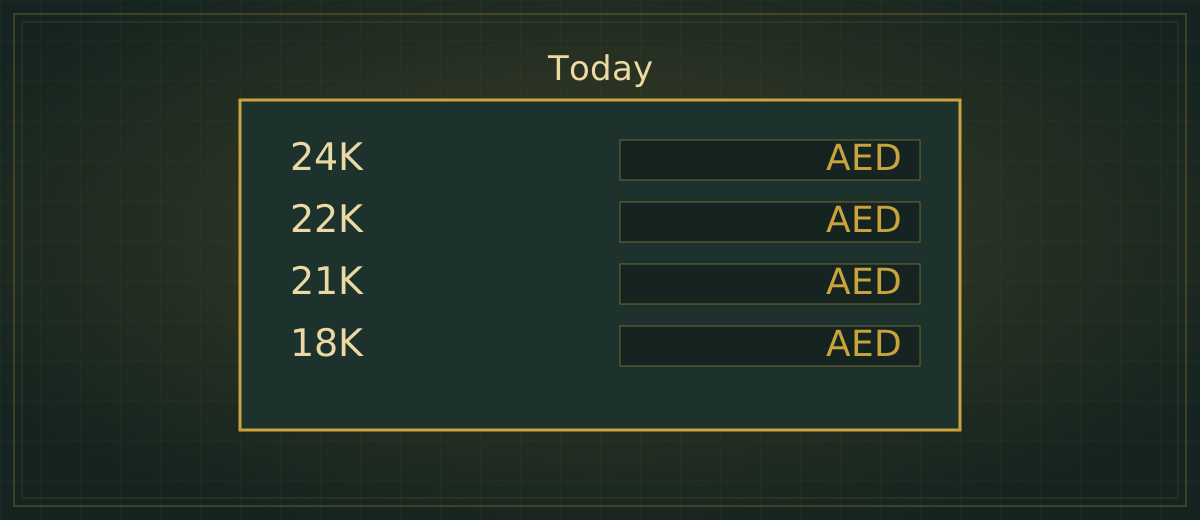
The Dubai Gold & Jewellery Group rate: what it is
The Dubai Gold & Jewellery Group (DGJG) is an association of gold and jewellery retailers, wholesalers and manufacturers in Dubai. One of its practical roles is to publish a daily retail gold rate in dirhams per gram for 24K, 22K, 21K and 18K, which member shops display on the screens and boards you see in Deira, Karama, Meena Bazaar and the malls. The rate is updated more than once a day when the international market moves, and shops are expected to sell metal at or very near it, competing on making charges rather than on the metal price.
The board below is our live equivalent, calculated directly from the spot price:
Gold rate in Dubai today
…
| Purity | AED / gram | USD / gram | AED / 10 g | AED / tola |
|---|---|---|---|---|
| 24K (999) | … | … | … | … |
| 22K (916) | … | … | … | … |
| 21K (875) | … | … | … | … |
| 18K (750) | … | … | … | … |
The same daily rate applies in all seven emirates. International spot price converted to dirhams at the official peg (1 USD = 3.6725 AED). Shops quote the Dubai Gold & Jewellery Group rate plus making charges and 5% VAT on the labour.
The DGJG rate exists to make the market transparent. A tourist in the Gold Souk can look at any wall, see the same figure, and know that the only thing to negotiate is the labour. That transparency is a large part of why Dubai is trusted for gold, and why the question "who sets the gold rate in Dubai" has such a simple answer: the trade itself, following the world price.
From London and COMEX spot to a dirham per gram
Gold's world price is formed in two places. The London over-the-counter market, where banks and refiners trade physical and unallocated gold, produces the continuous spot price and the twice-daily LBMA benchmark. COMEX in New York trades gold futures, and its most active contract is what most news screens quote in US trading hours. The two move together within a few dollars, with futures sitting slightly above spot because of financing costs.
Converting that to Dubai takes three steps:
- Take the spot price per troy ounce in US dollars.
- Divide by 31.1035 to get the price per gram of pure gold.
- Multiply by 3.6725, the dirham's peg to the dollar since 1997.
That gives the 24K gram rate. The 22K rate is 91.6% of it, 21K is 87.5% and 18K is 75%, matching each karat's gold content. The DGJG adds a small adjustment for refining and distribution, which is why its 24K figure can sit a dirham or two above the pure arithmetic. Our spot price in USD page shows the ounce figure these calculations start from, and the 22K and 21K pages show the karat rates most shoppers need.
Why Khaleej Times, Gulf News and Al Khaleej show the same gold rate
Searches for "Khaleej Times gold rate", "Gulf News gold price" or "Al Khaleej gold rate" are among the most common gold queries in the UAE, and people are often puzzled that every outlet prints an identical number. The reason is simple: the newspapers do not calculate a rate, they republish the DGJG retail rate, usually in a table of 24K, 22K, 21K and 18K per gram, sometimes alongside the dollar ounce price and a short market note. Arabic-language outlets such as Al Khaleej and Al Bayan do the same for their readers.
Differences you may notice between outlets come from timing, not source. A morning table reflects the rate at the time the page was prepared; by afternoon the DGJG may have updated and one site may have refreshed while another has not. If two newspapers differ by a dirham per gram on the same day, the later one is almost always the correct one at that moment. A live page like this one avoids the issue by recalculating from the spot price continuously rather than copying a snapshot.
When the Dubai gold rate updates during the day
There is no single daily fixing in Dubai. The DGJG refreshes its rate when the international price moves enough to matter, which in practice means several updates on an ordinary day and many on a volatile one. The busiest periods for changes, in Dubai time, are:
| Dubai time | What is happening | Typical effect |
|---|---|---|
| Early morning | Asian trading, India and China demand | Small moves; shops open with a fresh rate |
| Early afternoon and early evening | LBMA benchmark auctions in London (10:30 and 15:00 UK time) | Reference points many contracts use |
| Around 16:30–17:30 | US economic data releases | Largest intraday moves on data days |
| Evening | New York futures session | Moves continue after many souk shops have set their final rate |
| Saturday and Sunday | Global market closed | Friday's last rate stays until Monday morning |
Because shops may hold a rate for an hour or more while the world price keeps moving, a quote collected at noon can be out of date by evening. On a fast-moving day it is worth asking the shop when its board was last updated and comparing with the live board above.
Buying rate versus selling rate
The published rate is the price at which shops sell metal to you. When you sell gold back, whether old jewellery, a bar or a coin, the shop pays a selling rate that sits a little below the published figure. The gap is the dealer's spread: it covers testing, refining losses on jewellery, and the risk that the market falls before the shop can resell. For 24K bars and coins from a known refiner the spread is narrow; for 22K or 21K jewellery it is wider, and the making charges you paid originally are never recovered.
Both sides of the spread move with the DGJG rate during the day, so timing a sale on an afternoon when the world price has jumped can be worth more than haggling. Knowing the published rate before you walk in is the single most useful protection, and the selling gold in Dubai guide explains how buyers test purity and what a fair deduction looks like.
Why two shops can differ slightly on the same day
The metal rate is common to every jeweller in the country, but a handful of things can make two receipts look different for the same gram weight:
- Update timing. One shop refreshed its board ten minutes ago; the other is still on the morning rate.
- Rounding. Some shops round the gram rate to the nearest dirham or 25 fils.
- Making charges. By far the largest source of difference, and the one to compare; see gold making charges in Dubai.
- Promotions. A chain may advertise a discount that effectively lowers the labour or includes a free gram, while the metal line stays the same.
- Karat confusion. A 21K quote compared with a 22K quote will always look cheaper per gram; check the stamp.
If two shops differ by more than a couple of dirhams per gram on the metal line itself, something other than the rate is going on, and it is usually worth asking for an itemised quote. Our guide to the big jewellers covers how the chains present their prices.
How this site's live board relates to the DGJG rate
Our board does not copy the DGJG or any newspaper. It fetches the international spot price, converts it to dirhams at the peg and applies the karat purities, refreshing every couple of minutes while the page is open. In normal conditions the result lands within a dirham or so of the shop rate for each karat; the gap reflects the DGJG's small trade adjustment and the time since its last update. We show the pure calculation deliberately, because it tells you where the shop rate is heading before the board on the wall catches up.
Use the two together: the live board for direction and for working out budgets with the gold calculator, and the shop board for the exact figure on your invoice. Over weeks and months the price history page shows the same spot-derived rate so you can see trends without the noise of newspaper snapshots. All prices on this site are indicative and nothing here is a recommendation to buy or sell.
Frequently asked questions
Who sets the gold rate in Dubai?
The Dubai Gold & Jewellery Group, the jewellers' trade association, publishes the retail rate per gram that shops display. It derives from the international spot price in US dollars, converted to dirhams at the 3.6725 peg, with a small adjustment for the local trade. Nobody in Dubai decides the price of gold itself; the world market does.
Is the Khaleej Times gold rate different from the Gulf News gold rate?
No. Both republish the Dubai Gold & Jewellery Group rate, so on the same update they show identical figures. Any difference of a dirham or so between them reflects one page being refreshed later than the other during the day, not a different source.
How many times a day does the Dubai gold rate change?
Several times on an ordinary day and many on a volatile one. The DGJG updates when the spot price moves meaningfully, and shops refresh their boards at intervals. The world market trades from Monday morning in Asia to Friday evening in New York, so the rate is static over the UAE weekend.
Why is the rate on this site slightly different from the shop?
Because we calculate continuously from the spot price while the shop displays the DGJG rate as of its last update, plus a small trade adjustment. The two normally agree within a dirham or two per gram; a larger gap usually means the shop's board has not been refreshed recently.
Is the gold rate the same across all seven emirates?
Yes. The Dubai rate is used as the reference in Abu Dhabi, Sharjah, Ajman and the other emirates because the whole country shares one currency peg and one import regime. Making charges and selection vary from souk to souk, but the metal rate per gram is the same figure nationwide.
Keep reading
-
 Gold Spot Price in USD per Ounce – World Gold Price Live from Dubai
Live gold spot price in US dollars per troy ounce, explained from Dubai: what spot means, LBMA fix vs COMEX futures, trading hours and the AED gram rate.
-
 22K Gold Rate Today in UAE – 22 Carat Gold Price in Dubai per Gram, 10 g and Tola
Live 22K gold rate today in UAE and Dubai per gram, 10 g and tola in AED and USD: what 916 means, making charges, buying vs selling rate, hallmark checks.
-
 21K Gold Rate Today in UAE – 21 Carat Gold Price per Gram in Dubai (875 Gold)
Live 21K gold rate today in UAE and Dubai per gram and 10 g: what 875 gold is, 21K vs 22K, bridal shabka budgeting, buying tips for Sharjah and Ajman.
-
 Gold Rate History in the UAE – Dubai Gold Price Chart for the Last 6 Months and Beyond
Historical gold rate in the UAE on one chart: the Dubai gold price per gram over the last month, 6 months and years, how to read it and when to buy.
-
 Gold Making Charges in Dubai – How They Are Calculated and How to Negotiate
Gold making charges in Dubai explained: per-gram vs percentage, typical ranges, what zero making charges really mean, how to negotiate and worked examples.
-
Gold Rate in UAE Today – Rates by Emirate, Karat and Currency
Gold rate in UAE today for every emirate and karat: 24K, 22K, 21K and 18K per gram in AED, USD, INR and PKR, plus calculator, history chart and spot price.
-
 Gold Rate in Abu Dhabi Today – 24K, 22K and 21K per Gram
Today's gold rate in Abu Dhabi, live for 24K, 22K, 21K and 18K per gram in AED, plus where to buy at Madinat Zayed Gold Centre, Hamdan Street and malls.
-
 Gold Rate in Al Ain Today – Live Price per Gram and Where to Buy
Today's gold rate in Al Ain per gram for 24K, 22K and 21K, plus a local guide to the Al Ain gold souk, Al Ain Mall and Bawadi Mall jewellers and Buraimi.