Gold Earrings in Dubai – Studs, Hoops, Jhumkas and Nose Pins by Weight
Gold earrings are the lightest gold most people buy in Dubai, and that changes the maths. A pair of studs may weigh 1 g and a pair of bridal jhumkas 10 g or more, and because the making charge is a bigger share of a light piece, the gold earrings price in Dubai depends as much on labour and backs as on the rate in the strip above. This page covers ladies' gold earrings by style, from studs and hoops to jhumkas, drops and chandbalis, gold nose rings and pins, children's earrings, the choice between 18K and 22K, screw-back versus push-back fittings, typical weights, and where in the UAE to buy them.
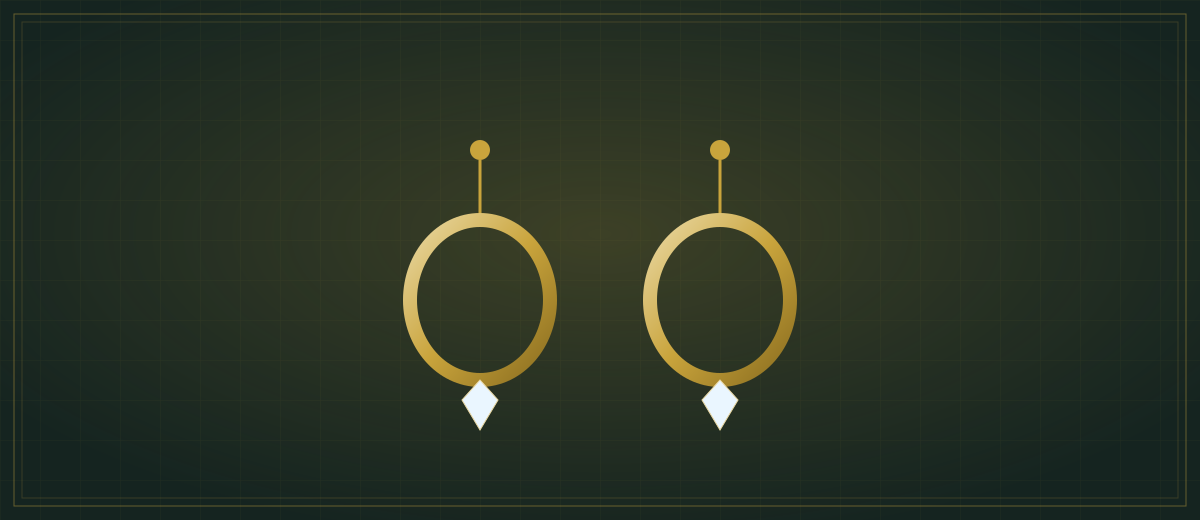
How the gold earrings price in Dubai is calculated
The formula is the one used for every piece of jewellery in the UAE: net gold weight × today's rate for the karat + making charge + 5% VAT. Earrings are weighed as a pair, including the posts, backs and any hooks, and the karat stamp is usually on the post or the back. What differs from a chain or a bangle is proportion. A 1.5 g pair of 22K studs contains very little metal, so even a modest per-piece making charge is a large percentage of the invoice; a 10 g pair of plain hoops is mostly metal and prices close to the board rate.
Shops therefore often quote earrings with a per-pair or per-piece making charge rather than per gram, especially on stone-set and designer pairs. Ask which it is, and ask for the net gold weight separately from any stones. The making charges guide gives the ranges you will meet for plain, patterned and stone-set work. As always, treat any figure here as indicative; the scale and the rate at the moment of purchase decide the final price, and the gold calculator gives you today's metal value for any weight.
Ladies' gold earrings by style and typical weight
Earring weights in Dubai shops cluster in a narrow 1–10 g band for the pair, with bridal pieces above that. The table below is what you will see on the scale across Deira, Meena Bazaar, Karama and Abu Dhabi's Madinat Zayed.
| Style | Usual weight (pair) | Notes |
|---|---|---|
| Gold stud earrings (plain ball, flower, star) | 1–3 g | Daily wear and gifts; screw-back common for safety |
| Stone-set studs (CZ, diamond) | 1.5–4 g gold | 18K for diamonds; stone priced separately |
| Small gold hoop earrings (bali) | 2–5 g | Tube hoops may be hollow; check |
| Large hoops, Arabic-style hoops | 5–10 g | 21K popular with Emirati and Arab buyers |
| Drops and danglers | 3–8 g | Turkish and Italian 18K, Indian 22K |
| Jhumkas | 4–12 g | Bell-shaped, often with pearls; bridal versions heavier |
| Chandbali and bridal earrings | 8–25 g | Half-moon, Kundan or Polki; sold with the necklace set |
| Kids' and baby earrings | 0.5–1.5 g | Screw-back, 22K or 21K, tiny studs |
For a quick check, multiply the pair's weight by today's gram rate for the karat and compare with the quote: on plain hoops and studs the gap should be modest; on jhumkas with pearls and enamel it is larger because of the handwork. Our 22K rate page and 21K rate page show today's figures for the two karats most earrings are made in.
Studs, hoops, jhumkas and drops: choosing the design
Gold stud earrings are the universal first purchase: a plain ball, a small flower, a star or an initial, bought for a baby's piercing, a daughter's birthday or as an Eid gift. They are light, inexpensive in metal and easy to resell. Many Dubai shops keep a stud tray by the counter and will fit them while you wait.
Gold hoop earrings range from fine 2 g tube hoops to broad 21K Arabic hoops worn by Emirati and Gulf women with the shayla. Hoops can be solid or hollow tube; hollow is lighter and cheaper but dents if squeezed, so ask. Hinged hoops with a snap closure are more secure than open wire hoops.
Jhumkas, the bell-shaped earrings of South Asia, are the signature 22K design in Meena Bazaar and Karama, often finished with pearls, enamel or small bells, with chandbali half-moon earrings for weddings. Drop and dangler earrings in 18K from Turkish and Italian lines suit evening wear and office wear and come in rose, white and two-tone gold. Whichever style, hold the earring up to your ear in the shop and move your head: weight that feels fine on the palm can pull on the lobe after an evening. The Dubai Gold Souk and the Meena Bazaar showrooms carry the deepest earring ranges in the city.
Gold nose rings and nose pins
A gold nose ring or nose pin (nath or nathni in India, a stud or small hoop in Gulf and Arab styles) is one of the lightest gold items sold in the UAE, often well under 1 g for a pin and 1–3 g for a hoop or bridal nath with a chain. Because the metal is so light, the price is mostly making charge, and shops frequently quote a fixed per-piece figure. That is normal; what matters is that the karat is stamped and the piece is sized for your piercing.
Nose pins come as screw-type (a twisted wire that turns in), straight pin, L-shaped and bone-style posts, and small hinged hoops. Screw-type and L-shaped posts stay put best; straight pins can slip. For a new piercing, 22K or 18K are both fine; 18K is a little stiffer and easier to insert, while 22K is softer and gentler on healing skin. Diamond nose pins are usually 18K with a tiny stone priced separately. The bridal nath with a chain to the hair is heavier and is often sold alongside the 22K wedding set. Ask whether the shop can adjust the gauge, as most Deira and Karama jewellers can thin or shorten a post while you wait.
18K vs 22K gold earrings: which to choose
Earrings take less wear than rings, so softness matters less than for a band, but fittings matter a great deal. 22K (916) is the choice of Indian, Pakistani and Sri Lankan buyers for studs, hoops and jhumkas: bright colour, maximum gold value per gram, easiest resale. The posts are soft, so screw-backs and thicker posts are used to stop bending. 21K (875) is what Emirati, Egyptian, Levantine and other Arab buyers favour for hoops and drops: slightly harder, deeper yellow, a little cheaper per gram. 18K (750) is the standard for diamond studs, rose and white gold, Italian and Turkish fashion earrings and anything with delicate prongs; the harder alloy holds stones securely and keeps thin posts straight.
If the earrings are for a child or for a daily pair you will not think about, 22K or 21K studs with screw backs are the practical choice. If the pair carries diamonds or has fine prongs, 18K is safer. The purity stamp (916, 875 or 750) is on the post or the butterfly back; the gold karats guide explains colour and hardness in detail, and the white and rose gold page covers why coloured earrings are almost always 18K and need occasional re-plating.
Screw-back vs push-back fittings and other backs
Earring backs are where most losses happen, so spend a minute on them in the shop.
- Screw-back (threaded post with a screw-on nut) – the South Asian standard and the safest for children, 22K studs and anything worn daily. Hard to lose, slightly slower to put on. Check the thread turns smoothly and does not strip.
- Push-back (butterfly or friction back) – the standard on 18K and designer studs. Quick and comfortable; the butterfly can loosen with time and is easy to lose. Many jewellers will swap a push-back for a screw-back for a small fee.
- Lever-back and hook – for drops and danglers; lever-backs close securely, plain hooks rely on a rubber or gold stopper.
- Snap or hinged closures – on hoops and bali; make sure the hinge clicks firmly shut.
- Clip-on and omega backs – for unpierced ears or heavy bridal pairs; omega backs take some weight off the lobe.
Backs count towards the weight you pay for, and gold backs are more secure than plastic or silicone stoppers. If a 22K post has bent, do not straighten it yourself; most Dubai jewellers will straighten or replace it on the spot.
Kids' earrings, gifts and small budgets
Baby and children's gold earrings are a steady business in the UAE: Eid, Diwali, naming ceremonies, first birthdays and school results all come with a tiny pair of studs. These weigh 0.5–1.5 g, are almost always 22K or 21K, and come with screw-backs and short posts so they cannot be pulled out or scratch the neck. Because the metal is so light, the per-pair making charge is a large share of the price, which is normal; compare a few shops on the total rather than the per-gram figure.
Small budgets have other options too. A 1–2 g pair of plain 21K or 22K studs is the cheapest real gold most shops sell, and often the gift of choice for colleagues and household staff before Eid. Slightly larger budgets open up 3–5 g hoops or drops. If you are buying as a gift for someone overseas, carry the invoice; earrings fall comfortably within most countries' personal allowances, and Indian residents have a modest duty-free limit for jewellery that a light pair does not threaten. Tourists can reclaim the 5% VAT on departure; see the VAT on gold page for the Planet refund steps.
Where to buy gold earrings in the UAE, and resale
For 22K studs, jhumkas and bridal pairs, Meena Bazaar in Bur Dubai and the Karama showrooms have the widest Indian ranges and regular making-charge offers; the Deira Gold Souk mixes those with 21K Arabic hoops and Egyptian and Levantine drops, and labour is negotiable. For 18K diamond studs and Italian designs, the Gold & Diamond Park on Sheikh Zayed Road and the mall jewellers are the places. In Abu Dhabi, Madinat Zayed Gold Centre carries both Emirati 21K and South Indian 22K pairs; Sharjah's Central Souk and Rolla area are worth a look for plain hoops at keen labour. The best gold jewellers guide notes which chains specialise in which style.
On resale, plain earrings in 22K and 21K are easy to sell back by weight at the day's selling rate minus a small margin; stone-set and enamelled pairs lose their making charge and stone value, and 18K fashion pairs recover the least. Keep the invoice and the purity stamp intact, and sell earrings as a pair, since single earrings are paid as scrap. The selling gold in Dubai guide explains how a buyer weighs, tests and deducts for backs and stones so there are no surprises.
Frequently asked questions
How much do gold earrings cost in Dubai?
The pair's net gold weight multiplied by today's rate for its karat, plus a making charge and 5% VAT. Plain studs weigh 1–3 g and hoops 2–10 g, so the metal cost is small; on light pieces the making charge is a larger share. Check the live rate above and ask the shop for the weight and making charge separately.
Are 22K or 18K earrings better for daily wear?
Both work. 22K studs with screw-backs are soft but secure and hold the most gold value; 18K earrings are harder, keep thin posts straight and hold stones safely, which is why diamond studs are 18K. For children, 22K or 21K screw-back studs are the usual choice; for diamond or prong-set pairs choose 18K.
Which earring back is safest?
Screw-backs, where a nut threads onto the post, are the hardest to lose and the standard for 22K studs and children's earrings. Push-backs are quicker but can loosen. Most Dubai jewellers will convert a push-back pair to screw-back for a small charge, and gold backs are more secure than plastic stoppers.
How much does a gold nose pin cost in Dubai?
Nose pins often weigh under 1 g, so the metal value is tiny and shops usually quote a fixed per-piece price that is mostly making charge. Hoops and bridal naths with chains weigh 1–3 g. Check that the karat is stamped and ask the jeweller to adjust the post gauge or length to your piercing.
Can I buy earrings for a baby in Dubai?
Yes. Baby studs of 0.5–1.5 g in 22K or 21K with screw-backs and short posts are stocked by almost every jeweller in Deira, Karama and Abu Dhabi. Choose a smooth design without sharp edges and have the shop confirm the post length. Piercing itself is done by clinics and some pharmacies, not by gold shops.
Do hollow gold hoops cost less?
Yes, because they contain less gold for the same size and price is by weight. Hollow tube hoops look bold but dent if squeezed and are hard to repair. For everyday hoops choose solid or thick-walled designs with a hinged snap closure; keep hollow hoops for occasional wear.
Keep reading
-
 Gold Necklace Price in Dubai – 22K Necklace Sets, Chokers and Pendants
Gold necklace price in Dubai and the UAE: how 22K necklace sets are priced by weight, bridal sets, chokers, pendants, stone-set vs plain, regional styles.
-
 Gold Bracelets and Bangles in Dubai – Prices by Weight, Sizes and Styles
Gold bracelet and bangle prices in Dubai: 22K Indian and 21K Emirati bangles, men's bracelets, anklets, kada, sets of 4 or 6, sizing and making charges.
-
 Gold Ring Price in Dubai – What a 22K, 21K or 18K Ring Really Costs
Gold ring price in Dubai and the UAE: typical weights for ladies' and men's rings, the weight × rate + making charge formula, 22K vs 21K vs 18K rings.
-
 Gold Karats Explained: 24K vs 22K vs 21K vs 18K (999, 916, 875, 750) in the UAE
What 24K, 22K, 21K and 18K gold mean, what the 999, 916, 875 and 750 stamps tell you, which karat suits which jewellery, and how each is priced in the UAE.
-
 Gold Making Charges in Dubai – How They Are Calculated and How to Negotiate
Gold making charges in Dubai explained: per-gram vs percentage, typical ranges, what zero making charges really mean, how to negotiate and worked examples.
-
 Dubai Gold Souk in Deira: Guide to Shops, Opening Hours, Haggling and the Extension
Guide to the Deira Gold Souk in Dubai: layout in Al Ras, the Gold Souk Extension, opening hours, haggling, scams to avoid, bridal shopping and transport.
-
 Gold Chain Price in Dubai – 22K Chains for Men and Women by Weight
Gold chain price in Dubai: what 10 g, 20 g and 50 g chains cost by karat, rope, Figaro, box and Cuban designs, hollow vs solid gold, and making charges.
-
 White Gold, Rose Gold, Black Gold and Champagne Gold: What They Are and What They Cost in Dubai
White gold, rose gold, black gold and champagne gold explained: alloys, rhodium plating, allergies, care, what to check on the stamp and prices in Dubai.